What we mean by a ‘human reset’
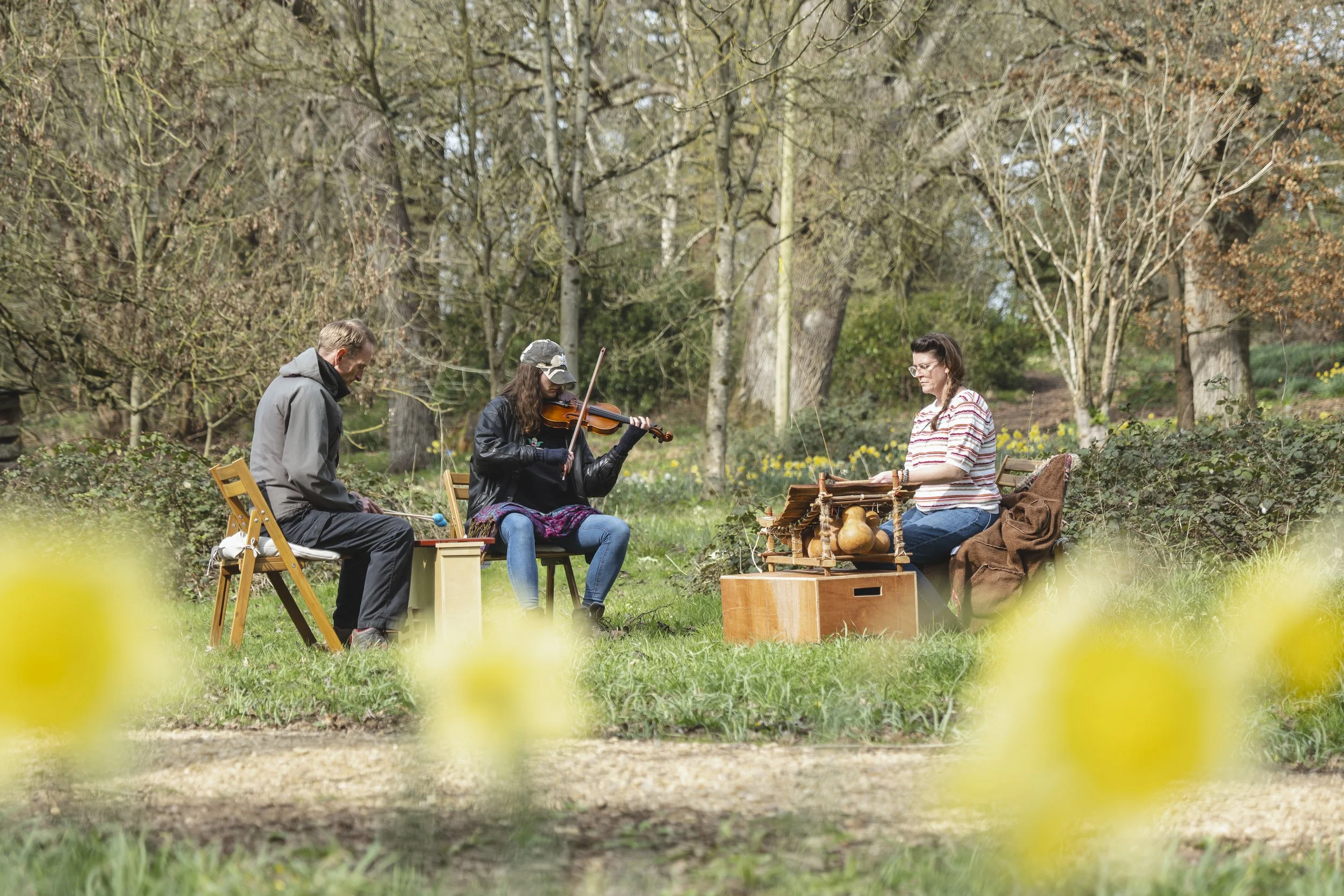
A small group working on a composition. One of them had never done this before.
It's not a workshop. It's not a retreat. It's not therapy. It does something each of those often promises, yet rarely delivers.
Here's what we actually mean when we use the words.
"I didn't realise how much I needed this."
That's the sentence we hear most often from people who spend a day with us in the woods.
Not "that was relaxing" or "what a nice day." Something closer to surprise. Like something you didn't know was locked has quietly opened.
That's what we mean by a human reset.
Not fixing something that's broken. Creating the conditions for something that's been under strain for a long time to settle, reorganise, and come back online.
You're not broken. You're overloaded.
If you're reading this, you're probably good at your job. You carry responsibility. You deliver. People rely on you, and you'd describe yourself, honestly, as someone who copes.
But somewhere underneath the calendar invites and the relentless pace, you know something isn't quite right.
Not dramatic. Not urgent. Just... unsustainable.
You've likely tried the obvious things. A mindfulness app. A weekend off. A retreat. Coaching. Maybe therapy. Some of it helped, briefly. None of it quite changed how you actually feel and function a week later.
That's not a failure of effort. It's a mismatch of approach.
Most wellbeing offers focus on what you should do differently. Fewer address the underlying system that determines whether you can.
What a human reset is not
We want to be very clear about this.
It is not a workshop. Nothing is taught. You won't leave with a framework or a worksheet.
It is not a retreat. It lasts a single day. No flights. No extended time away. No spiritual performance required.
It is not therapy. You won't be asked to explain yourself, analyse your past, or name your feelings.
What a human reset actually is
A human reset is a carefully structured day in which your system is given a combination of conditions that rarely occur together in modern professional life.
Those conditions are simple, but precise.
You are in beautiful, quiet nature. You are with other people, but not required to perform for them. You are making something, but no one is judging how you make it. The day is professionally held, so you do not have to manage it. There is food. There is fire. There is time. Your phone is not in your hand.
Individually, none of these are unusual. Together, sustained over a full day, they allow the nervous system to downshift, stabilise, and reset its baseline.
You don't usually notice it happening.
You notice it afterwards: in the car home, the next morning, or the following Tuesday, in a meeting that would normally have triggered you. You respond differently. More steadily. More clearly. More constructively.
Something has moved.
Why music? Why nature? Why together?
Each element is doing specific work.
Music
Creative music-making in a group activates three conditions identified by Self-Determination Theory as essential for genuine human engagement: competence (you quickly experience yourself as capable), autonomy (there is no prescribed right answer, you make the decisions), and relatedness (you are creating something with others in real time, in real life).
Together, these drive a form of engagement that doesn't rely on pressure or performance. Which is something most professional environments struggle to sustain.
Nature
The physiological effects of time in green space are well established. Stress markers reduce. Heart rate variability improves. Attention restores.
These are not abstract benefits. They affect how well you recover from pressure, how clearly you think, and how sustainably you operate over time. Your system functions better when it is not under constant demand.
Together
This is the quietest ingredient, and the most powerful.
Most wellbeing practices are individual. But the quality of your working life is largely relational.
In this environment, you are not being evaluated. You are not competing. You are not required to present a version of yourself. That combination creates the conditions for psychological safety to emerge quickly and naturally.
When that happens, people communicate more openly, listen more fully, and collaborate more easily. Not because they've been told to. Because the underlying conditions allow it.
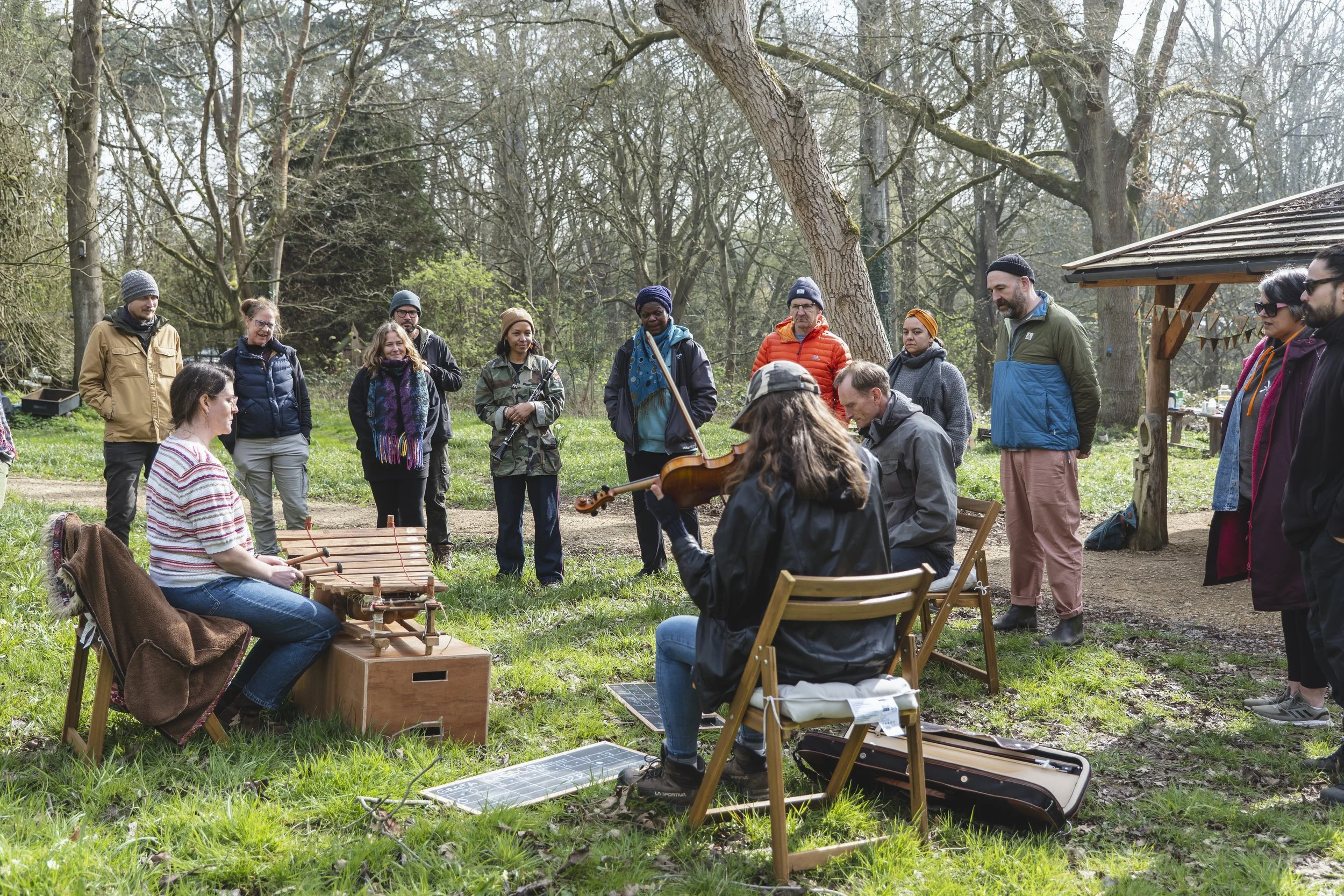
Participants gather to hear one of the groups’ composition
What actually shifts
We track impact across five core conditions that shape how people think, relate, and perform, both in the woods and back at work.
These are not abstract qualities. They are underlying states that determine how you respond to pressure, how you relate to others, and how effectively you can contribute.
Safety
In the woods: A felt sense of ease in the body that allows you to settle, connect, and respond rather than react.
Back at work: The ability to stay present, think clearly, and respond constructively under pressure.
Connection
In the woods: A sense of being meaningfully in relation with others, where interaction feels natural, mutual, and unforced.
Back at work: The foundation for trust, open communication, and effective collaboration.
Authenticity
In the woods: A feeling of being able to show up as yourself, without needing to perform, filter, or hold parts of yourself back.
Back at work: Reduced cognitive load from 'masking', and more honest contribution and clearer thinking.
Equity
In the woods: A sense that you can fully take part and belong, without needing to adapt who you are to fit in.
Back at work: Wider participation, more diverse perspectives, and stronger collective outcomes.
Creativity
In the woods: A state of openness where ideas, expression, and new ways of responding can emerge without effort or self-judgement.
Back at work: Flexible thinking, problem-solving, and the ability to approach challenges differently.
The feedback
After our pilot in March 2026, participants rated their experience. Every score came back between 4.5 and 4.8 out of 5.
But what people wrote afterwards said it more plainly: "I felt as though I belonged here." "I didn't look at my phone for hours." "Within hours I was creating a lovely composition."
Something had shifted. And people noticed.
If this sounds like you
You don't need to be musical. You don't need to have done anything like this before. You don't need to be anything other than open and curious.
Our next dates are in June, July, and August. The full programme is at soundinthewoods.com/eventsbookings.
If you'd rather talk it through first, reach out directly: siggy@soundoutside.com.
A human reset doesn't give you new tools.
It restores the conditions that allow the tools you already have to actually work.
Siggy Patchitt | Founder, Sound Outside